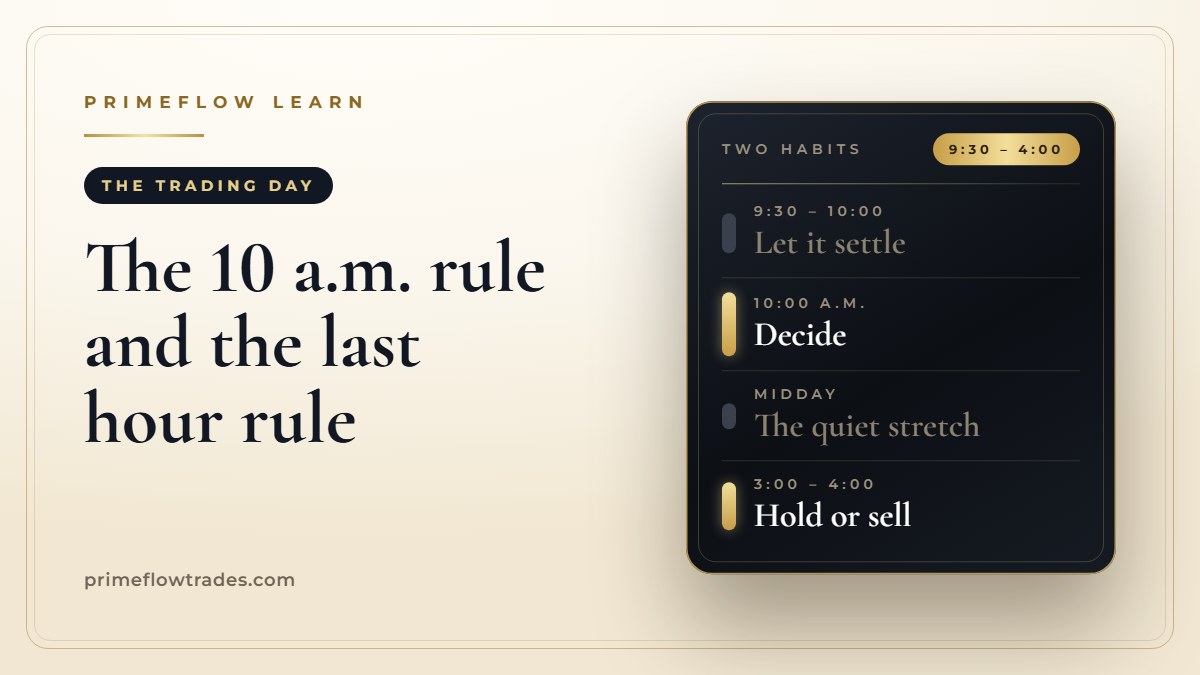
What is the 10 a.m. rule in stocks? It’s a habit, not a regulation: don’t buy anything in the first half hour after the opening bell, and make your decisions at 10:00 a.m. Eastern instead. Its partner at the other end of the day is the last hour rule, which says the final hour, from 3:00 to 4:00 p.m., is when you decide what you’re holding overnight. Put the two together and most of the trading day takes care of itself.
The short version
- The 10 a.m. rule: wait out the first 30 minutes of the session, then decide. No exchange or regulator requires it.
- Traders tell it three ways: no buying before 10:00, wait just 10 minutes, or watch 10:00 to 10:30 to see how the day shapes up.
- The last hour rule: treat 3:00 to 4:00 p.m. as decision time for anything you’re holding overnight.
- Many traders call that last hour the power hour. Activity picks up as people close out or set up for tomorrow.
- Both rules do the same job. They keep you from making your biggest decisions at the moments the market is rushing you.
What is the 10 a.m. rule in stocks?
The New York Stock Exchange and Nasdaq open at 9:30 a.m. Eastern time. In the next half hour, everything that happened overnight gets priced in with real money: earnings released after the close, an analyst’s upgrade, news from Europe and Asia. Prices jump, reverse and jump again.
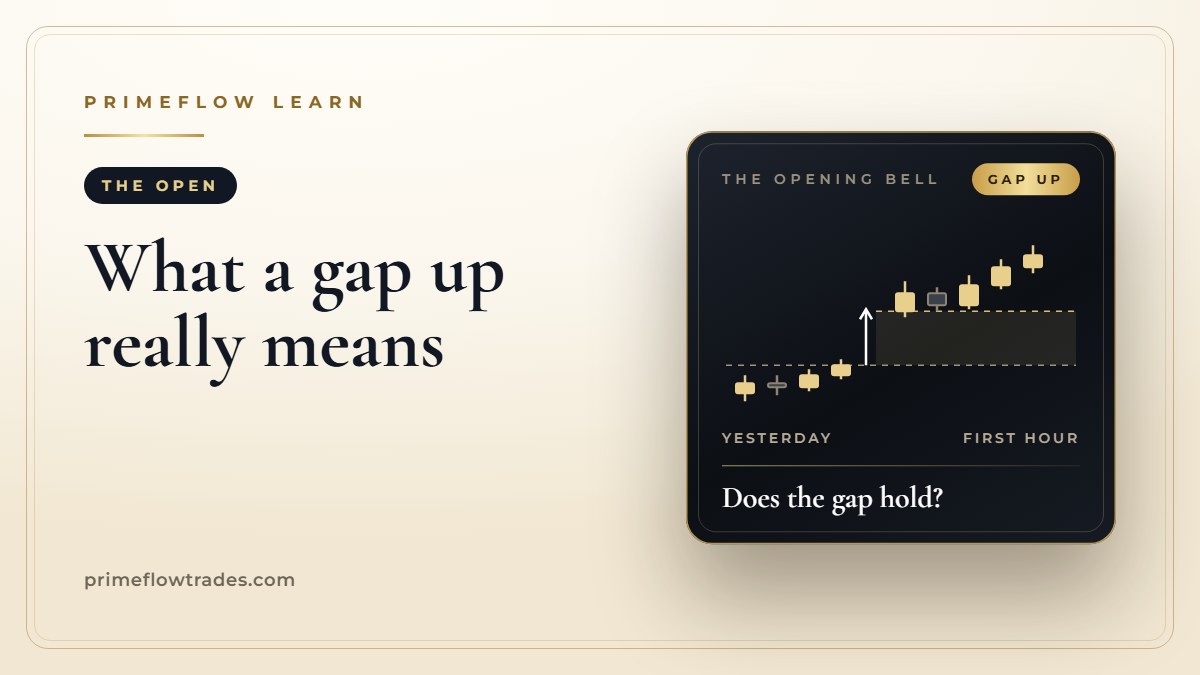
The 10 a.m. rule says you let that settle first. You watch, you don’t buy, and at 10:00 you look at what’s still standing. A stock that gapped up and is still holding most of the gain at 10 o’clock is telling you something real. One that spiked at 9:31 and is already sliding back has told you something too, and it cost you nothing to learn it.
Ask around and you’ll hear three versions. Some traders mean no trades of any kind before 10:00. Others shorten it to ten minutes and act at 9:40. A third group treats 10:00 to 10:30 as the window that shows whether the day will run in one direction or chop back and forth. They don’t disagree on the point. They disagree on how long to wait.
None of these is a rule in the legal sense. FINRA and the SEC set no waiting period, and your broker will happily fill an order at 9:30:01. It’s a habit traders keep because the first minutes are where the most expensive mistakes get made.
Why the first half hour fools people
At 9:32 a stock is up 7%, it’s on every screen, and buying feels urgent. That urgency is the problem. In those first minutes, overnight orders are still being filled, some buyers who piled in before the bell are already taking profits, and prices can swing several percent in either direction before anyone has a clear view.
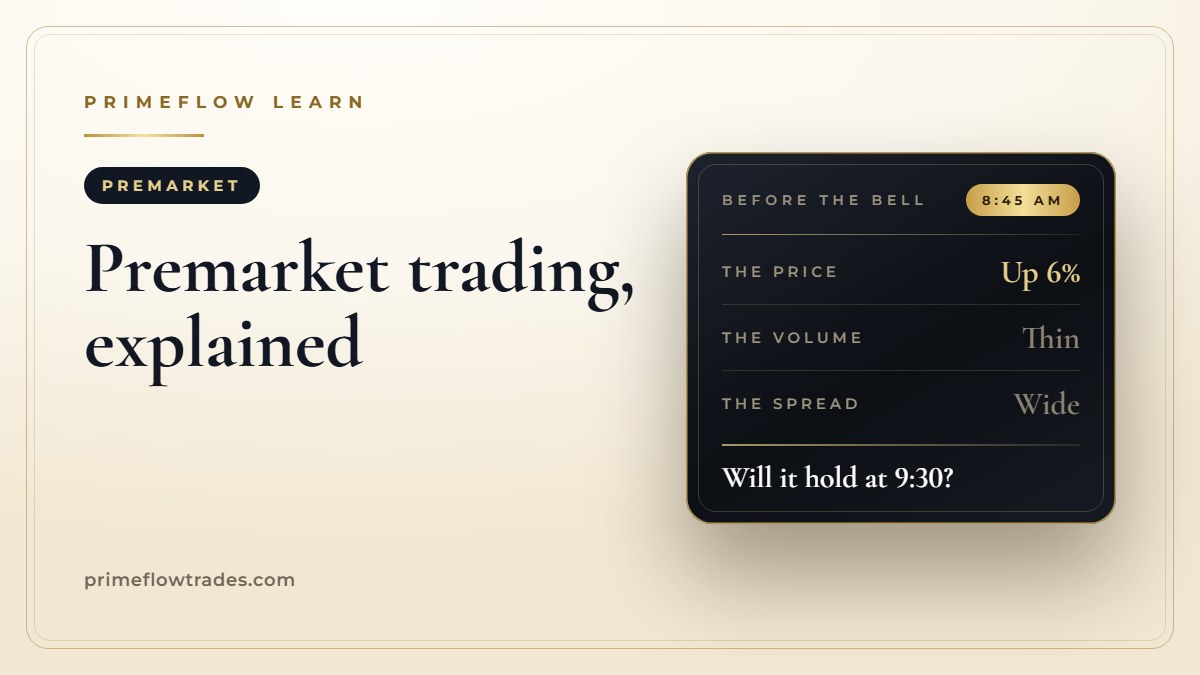
Early moves also start from shaky ground. Before the bell, far fewer people trade, and the SEC warns that thin trading can mean wider gaps between the bid and ask prices and bigger price swings than you’d see during regular hours. Our guide to premarket trading shows why so many early moves fade once the full market arrives at 9:30. A stock that gaps up at the open faces the same test: does the gain survive the first wave of selling?
Waiting until 10:00 gives you the answer before you pay for it.
When the 10 a.m. rule gets in your way
Like any habit, it has a cost. Some stocks make their whole move in the first 20 minutes and never look back. Wait for 10:00 and you’ll watch a few of those leave without you. That’s the trade you’re making: you give up the occasional early runner in exchange for skipping the far more common early fake.
The fix isn’t to drop the rule. It’s to stop needing the clock to tell you what to do. If you settled on your buy price the night before, you can place a limit order at that price with your broker and let the market come to you. It fills at your price or better, or not at all, whether that happens at 9:35 or 11:20. The rule was only ever there to stop impulse buys, and a price decided in advance does that job too.
What is the last hour rule in stocks?
The last hour rule covers the other end of the day. From about 3:00 to 4:00 p.m. Eastern, activity usually picks up again after the quiet midday stretch. Many traders call it the power hour. Some close out positions they don’t want to hold overnight, others buy ahead of tomorrow, and a lot of orders are aimed at the closing price itself: Nasdaq collects orders that ask to trade at the close and matches them at 4:00 p.m.
The rule is simple: the last hour is when you decide what you’re carrying into tomorrow. Not at noon, when nothing is happening, and not at 3:58, in a rush.
Look at where the stock is finishing. One that closes near the high of the day, with buyers still in control, is in very different shape from one that gave back its morning gains in the final half hour. Late moves can fool people too. A sharp jump at 3:45 can be a single large order being filled rather than a crowd of new buyers, and it often looks different by the next morning.
How the two rules fit together
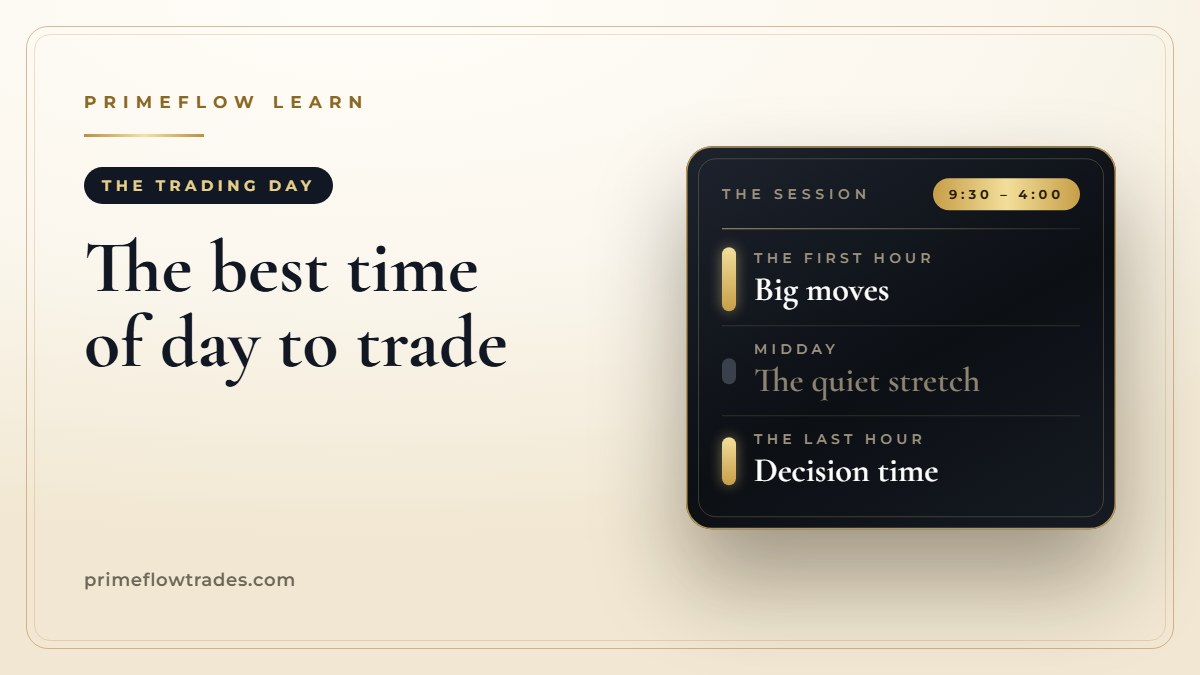
Put the 10 a.m. rule and the last hour rule side by side and you get a trading day with two decision points instead of six and a half hours of watching. Morning: decide what to buy, once the open has settled. Afternoon: decide what to hold, once the day has shown its hand. The middle of the day is yours. Our guide to the best time of day to trade stocks walks through the whole session hour by hour.
This is how a PrimeFlow alert is built to be used. Every alert gives you the buy price, two profit targets and a runner we let ride, all set before the trade. You place the order at the buy price and check in at set times. Our guide to reading a trade alert explains what each number is for.
The runner is where patience pays off. Our VSH alert went out at a buy price of $33.95 on May 8, 2026, and the stock reached $63.27 on June 3, 2026: up 86% in 26 days. Nobody needed to watch the opening bell every morning to hold it. Across our public trade log, 407 of our first 427 closed alerts were winners. If you’d like to see how we hold a position for weeks, our free 40-Day Retirement Position guide lays it out.
Common questions
What is the 10 a.m. rule in stocks?
It is a trading habit, not a regulation: don’t buy in the first 30 minutes after the 9:30 a.m. Eastern open. Wait until about 10:00, when the overnight news has been priced in and the early jumps have settled, then decide.
Is the 10 a.m. rule a real rule?
No exchange, broker or regulator requires it. FINRA and the SEC set no waiting period after the open, and brokers accept orders from 9:30 onward. It is a habit traders keep to avoid buying into the most unsettled part of the day.
What is the 10-minute rule in trading?
It is a shorter version of the same idea: wait about ten minutes after the open, until roughly 9:40 a.m. Eastern, before you buy, so the very first burst of orders has passed.
What is the last hour rule in stocks?
It treats the final hour of the regular session, 3:00 to 4:00 p.m. Eastern, as decision time for anything you plan to hold overnight. Activity usually picks up then, and where a stock finishes the day says a lot about who is in control.
What is the power hour in stocks?
The power hour is the last hour of regular trading, from 3:00 to 4:00 p.m. Eastern. Trading often picks up as people close out positions before the bell or buy ahead of the next day.
Should you buy stocks at the open?
Most traders are better off not chasing a stock in the first few minutes. If you’ve already chosen your buy price, a limit order at that price lets you get in at the open or later without guessing.
Sources
- SEC: After-Hours Trading, Understanding the Risks
- FINRA: Extended-Hours Trading, Know the Risks
- Investor.gov (SEC): Types of Orders
- Nasdaq: Opening and Closing Crosses
Trading hours and order types are summarized for general education. The 10 a.m. rule and the last hour rule are trading habits, not regulations. Check the hours and order types your broker offers.
PrimeFlow Trades publishes educational research and market commentary. Nothing on this page is investment advice or a recommendation to buy or sell any security. Trading involves risk, including the loss of money you invest. Past results, including any trade shown here, do not guarantee future results.