The old pattern day trader rule counted your trades. The standard that replaced it on June 4, 2026 measures what your account actually borrows during the day. It’s a different idea, and it’s worth understanding before your broker switches you over.
The short version
- Brokers now check whether your margin account ran short during the day, instead of counting day trades.
- A shortfall is covered by adding cash or reducing positions.
- Small shortfalls, up to the lesser of 5% of equity or $1,000, aren’t counted toward a pattern of unpaid deficits.
- A deficit still unpaid by the fifth business day can freeze parts of the account for 90 days.
From counting trades to measuring exposure
The old rule used a stand-in. It assumed anyone making four or more day trades in five days was taking day-trader risk, and it charged everyone who crossed that line the same $25,000 entry fee.
It missed in both directions. A trader making four tiny round trips got caught. A trader who put on one huge borrowed position and closed it the same afternoon didn’t.
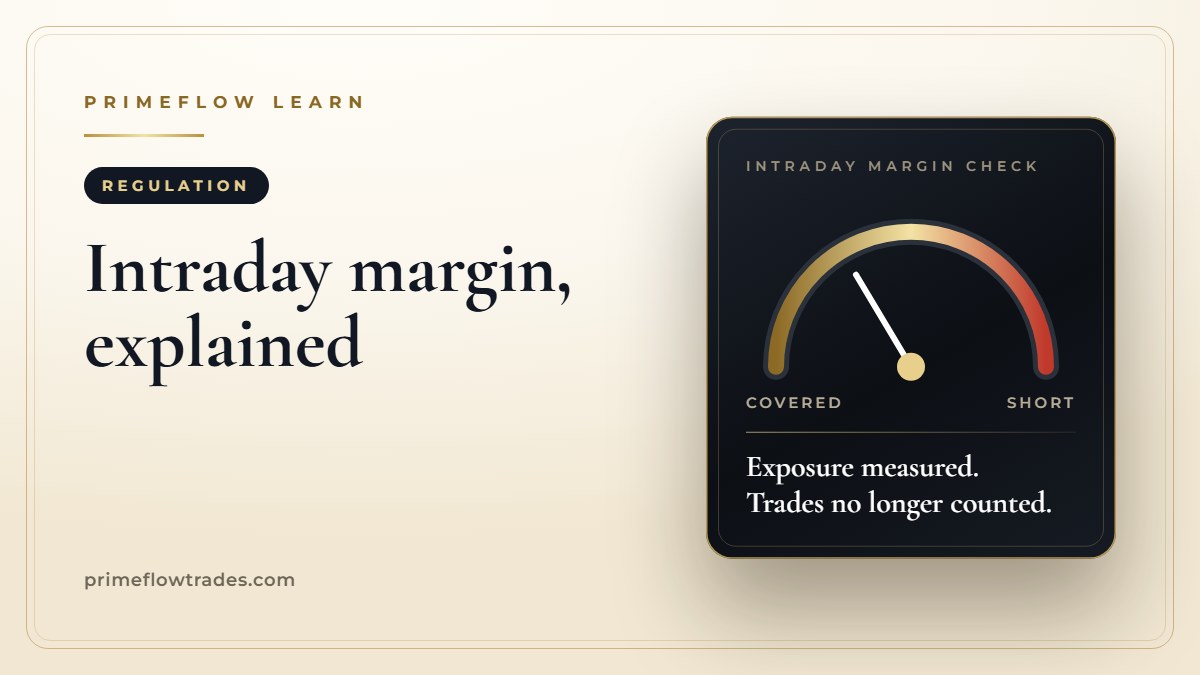
The new standard measures the thing the old rule was only guessing at: how much margin the account actually used during the session.
How the check works
On any day you make trades that use up margin, your broker works out whether the account ended up short of what it needed during the day. That shortfall is the intraday margin deficit.
If there is one, you cover it by adding money or by reducing positions. FINRA counts a deficit as covered once your deposits, or the margin you free up, match the shortfall between the end of that day and the end of a later day.
FINRA left brokers room in how they run the check. A broker can do a single calculation once a day instead of watching your account in real time, and can use current market prices when it does. That’s why the experience varies from one broker to the next.
The allowances and the penalty
Two kinds of shortfall aren’t held against you when a broker decides whether you have a habit of leaving deficits unpaid. The first is a small one: no bigger than 5% of the account’s equity or $1,000, whichever is lower. The second is one caused by extraordinary circumstances.
How the small-shortfall line works
The penalty has teeth. If a deficit is still unpaid by the fifth business day, the account can be barred from opening or growing short positions and margin loans for 90 calendar days.
One more change sits in the same notice: portfolio margin accounts holding less than $5 million in equity now have to include intraday margin in their risk monitoring.
Why this matters even if you never run short
The rules now scale with what you actually do. Trade small and you’ll barely notice them. Borrow heavily during the day and the system responds, whether that was one trade or ten.
For a careful trader, that’s a fairer deal. For a careless one, it removes the counter that used to force a break after a bad morning. Which one you get depends on the habits you bring. For the full story of the rule this replaced, read the pattern day trader rule is gone.
Common questions
What is an intraday margin deficit?
A shortfall in required margin created by trading during the day. Brokers calculate it on days when a customer makes trades that use up margin, and the customer covers it by adding money or reducing positions.
What are the exceptions to the intraday margin requirement?
Deficits no bigger than the lesser of 5% of the account’s equity or $1,000, and deficits caused by extraordinary circumstances, are not counted when a broker decides whether a customer has a practice of failing to cover deficits.
What happens if I don’t cover an intraday margin deficit?
If a deficit is still unpaid by the fifth business day, the account can be barred from creating or increasing short positions or margin debit balances for 90 calendar days.
Do brokers monitor margin in real time now?
Not necessarily. FINRA allows a single calculation per day instead of real-time monitoring, and allows brokers to use current market values. Practice varies from broker to broker.
Sources
Regulatory details are summarized for general education. Check the current requirements for your account with your broker.



PrimeFlow Trades publishes educational research and market commentary. Nothing on this page is investment advice or a recommendation to buy or sell any security. Trading involves risk, including the loss of money you invest. Past results, including any trade shown here, do not guarantee future results.