Most trading accounts that get badly hurt aren’t hurt by bad stock picks. They’re hurt by position sizes chosen in a hurry, and by decisions made in the middle of a bad day instead of before it.
The short version
- Decide how much goes into any one position before you look at a chart.
- Size each position so a sharp drop is an annoyance, not an emergency.
- Take profits on a plan you set before you buy.
- The trades you skip matter as much as the ones you take.
Size comes first, the stock comes second
The usual order is backwards. Most traders find a stock they like, pick a number of shares that feels right, and only later find out what a bad week does to the account.
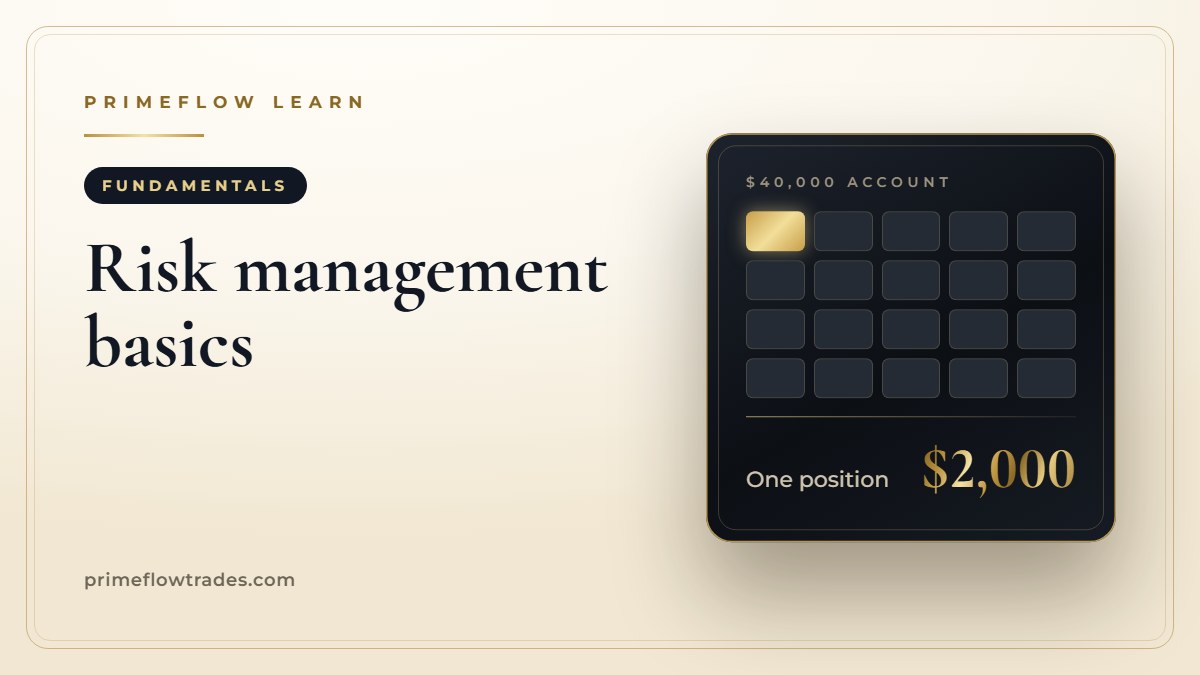
Flip it around. Decide first what slice of your account goes into any single position. Then let that number set the share count.
The math, with a $40,000 account and 5% per position
The 5% is an example, not a recommendation for your account. What matters is that the number exists before the chart does.
Size so you can sit through a rough week
Stocks that go on to make big moves rarely go straight up. Many dip first, some of them hard. The traders who get paid on those moves are the ones still holding.
The size of the position decides whether you can. At $2,000, a 20% drop costs $400, which is 1% of a $40,000 account. That’s a bad week, not a crisis, and you can wait it out calmly. Put $12,000 into the same stock and the same drop costs $2,400. Now every tick feels personal, and people who feel that way tend to sell at the worst possible moment.
A position you can hold calmly is a position you can give time to work.
Spread it across several positions
When every position is the same modest size, no single stock can decide your month. One that goes wrong is a small dent. One that runs is a real gain.
Keeping sizes equal also breaks a common habit: putting the most money into the idea you feel best about, which is not always the one that works.
Take profits on a plan
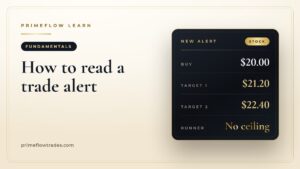
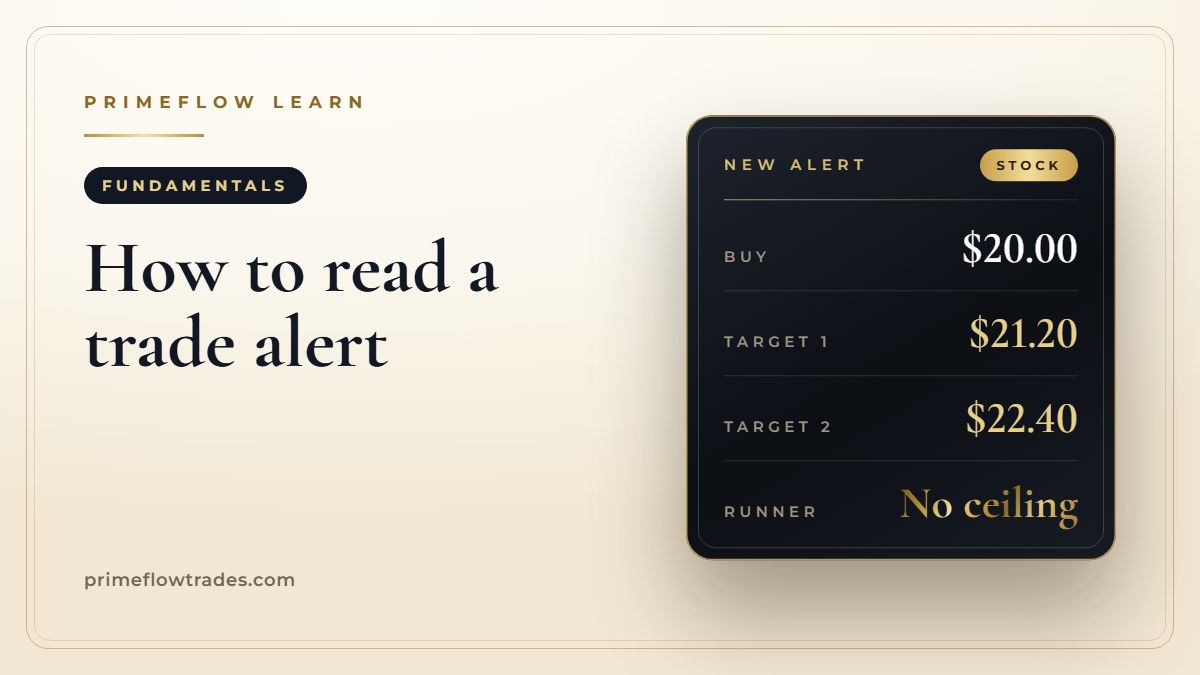
Decide where you’ll sell before you buy. A plan with two profit targets lets you bank gains in steps: some at the first target, more at the second, and a small piece left to run in case the move keeps going.
The value is in deciding early. A trader deciding in the moment, with the stock jumping around, tends to sell winners too soon. A trader with the plan written down just follows it. Here’s how a complete trade plan reads.
The trade you don’t take
Position size is the mechanical side of risk. The bigger side is choosing what to trade at all.
A surprising share of the damage in most accounts comes from a handful of trades that never should have happened: taken out of boredom, to win back a loss, or because a stock was already flying and it felt like missing out.
A habit that makes you skip those is worth more than any clever exit. Before any buy, ask one question: would I take this trade if I’d just had a great week? If the answer is no, it’s a revenge trade or a boredom trade, and it can wait.
Common questions
How do I calculate position size?
Multiply your account value by the share of it you’re willing to put into one position, then divide by the share price. For example, $40,000 × 5% = $2,000, and $2,000 ÷ $8 = 250 shares. The percentage is yours to choose. The point is to set it before you pick the stock.
How much of my account should go into one stock?
There is no single right figure. It depends on your account, your goals and your comfort with risk. Many traders keep each position to a small, fixed slice so that one bad stock can’t do serious damage. This is general education, not personal advice.
Why does position size matter so much?
Because size decides how a drop feels. A modest position can be held calmly through a rough stretch. An oversized one pushes people into selling at the worst moment.
What is a profit target?
A price, set before you buy, where you sell some or all of a position to lock in a gain. Using two targets lets you take profit in steps as the stock rises.
PrimeFlow Trades publishes educational research and market commentary. Nothing on this page is investment advice or a recommendation to buy or sell any security. Trading involves risk, including the loss of money you invest. Past results, including any trade shown here, do not guarantee future results.